


Midterm Clarity and Market Rotation: Why Fundamentals Support Our Positivity
 Market Commentary
As we head toward the final stretch of the year, two major events are reshaping the investment backdrop: the passing of the U.S. midterm elections and the unfolding corporate earnings season. While headlines often dwell on political drama or shifting market moods, our focus remains on underlying economic reality. The latest data highlights two clear themes for investors: U.S. midterm elections consistently act as a clearing event that removes political uncertainty, and the shift in market momentum away from a handful of tech giants toward the broader economy is driven by solid profit growth rather than mere speculation.
- Midterm Elections: Clearing the Political Fog
Elections inherently create noise and policy uncertainty, leading many institutional investors to temporarily pause active risk budgets. Once voting ends, however, markets historically regain their footing as that uncertainty lifts. Historical data consistently confirms this post-election boost across multiple time horizons.
Analysis from UBS shows that in midterm election years, the S&P 500 has gained an average of 6% from late September to December, extending to a 14% gain by the following March. JPMorgan data further reveals that since 1990, U.S. markets have posted average gains of 5.4% over three months and 14.7% over twelve months following a midterm vote. Indeed, Goldman Sachs notes that U.S. equities have been higher twelve months after every single midterm election since 1950.
This year features one important nuance highlighted by research firm BTIG. While midterm years typically experience a peak-to-trough pullback of nearly 14% between June and December, the 2026 drawdown was restricted to just 4.5%—marking the second-smallest mid-year dip since 1962. While a milder pullback means we may not witness a dramatic “coiled spring” snapback, clearing the political gridlock provides a clean path forward for investors to focus squarely on corporate health.
- Earnings Season: A Rotation Backed by Real Profits
For the past two years, stock market returns were heavily dominated by a handful of technology giants known as the “Magnificent 7”. Recently, however, investment flows have visibly broadened across traditional sectors, value stocks, and wider market benchmarks. Crucially, this shift is not a temporary whim; it is firmly anchored in actual corporate performance.
According to recent FactSet research, S&P 500 companies are reporting overall third-quarter profit growth of 30.2%, marking the eighth consecutive quarter of double-digit earnings expansion. Notably, every single economic sector is generating year-over-year revenue and profit growth, led by energy, healthcare, and industrial companies.
Most importantly, the nature of this profit growth has shifted. For the first time since late 2022, the remaining 493 companies in the S&P 500 are generating higher year-over-year profit growth (32.6%) than the Magnificent 7 (22.6%). This fundamental re-acceleration across the wider business landscape confirms that economic strength is spreading well beyond tech heavyweights, justifying the broader market rotation.
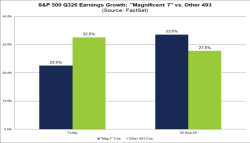
(Image Source: “Mag 7” Now Reporting Lower Earnings Growth Than the Other 493 S&P 500 Companies for Q3)
- Navigating the Great Divide: Discretionary vs. Systematic Investing
While we remain positive on broader economic growth, translating that outlook into client portfolios requires navigating a growing split in the fund management world. Today, the investment universe is increasingly divided into two distinct camps: discretionary managers and systematic managers.
Discretionary stock-pickers tend to be contrarians who exercise caution around stretched valuations, often holding back from market darlings in search of underpriced bargains. Conversely, systematic managers rely on rule-based algorithms that track momentum, automatically buying into whichever companies are performing best—which often means piling into the largest index giants. For asset allocators, this split creates a binary trap, where portfolios either hold massive, concentrated positions in a few stock market heavyweights or miss out on index momentum entirely.
At Wise Investment, we are currently balancing that risk by allocating capital to both discretionary and systematic managers. However, because human stock-pickers today lean so heavily into contrarian stances, relying solely on traditional equity managers would limit our ability to fully participate in broader equity market rallies. Because we remain constructive on the economic backdrop, we do not want our hands tied by manager caution. Rather than forcing stock-pickers to buy overvalued technology shares, we are capturing market growth through alternative engines: securing attractive, reliable yields in high-quality corporate credit, overweighting cyclical industries like industrials and materials that benefit directly as growth broadens and maintaining exposure to physical real assets and energy producers that offer tangible growth while protecting against inflation volatility.
With political noise fading and corporate profit growth broadening across the real economy, the fundamental picture remains encouraging. By blending systematic discipline with selective stock-picking—and backing that up with targeted investments in real assets and corporate credit—we ensure your portfolio stays positioned for long-term growth without taking unnecessary concentration risks.

